Software Engineering · AI Systems · Infrastructure
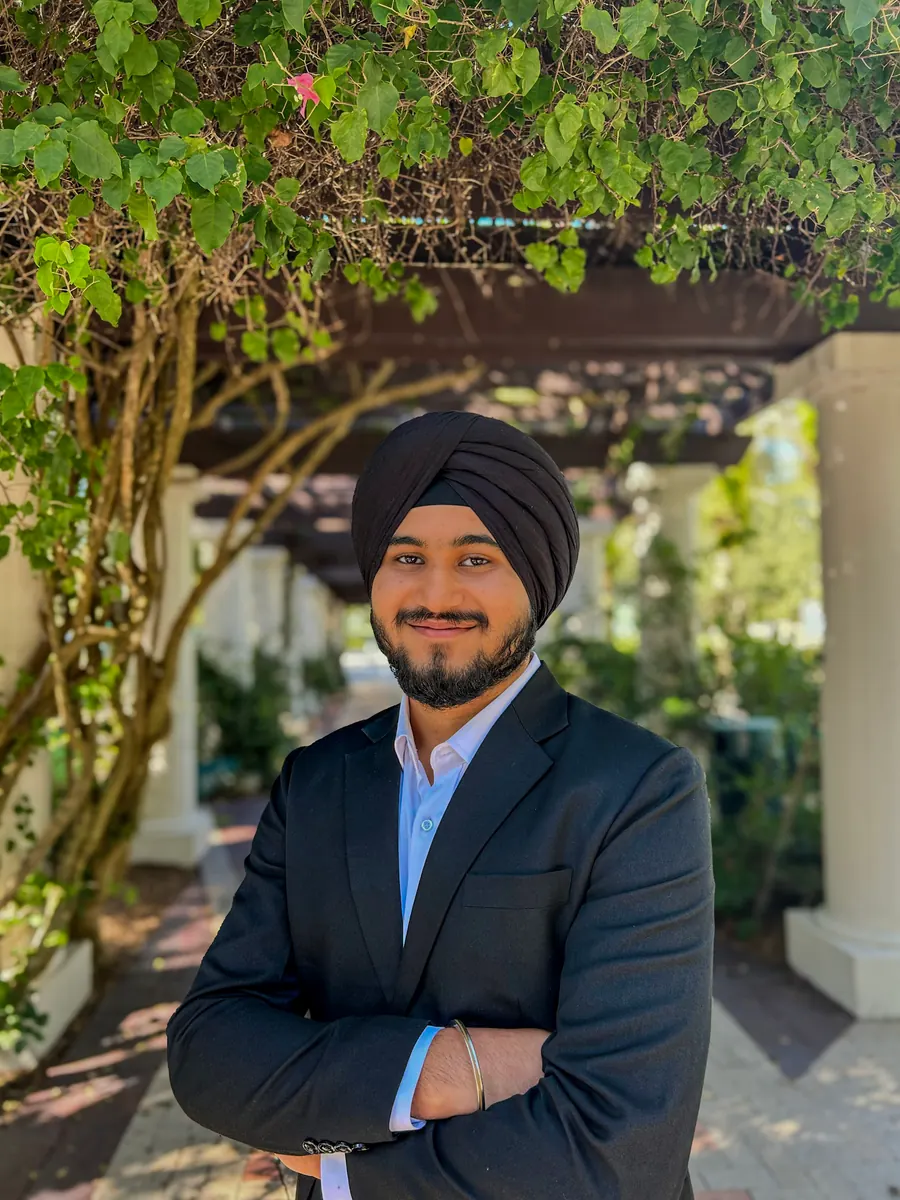
Hey, I'm Paramveer.
Software engineer building AI systems, backend infrastructure, and production products. Columbia M.S. Artificial Intelligence ’27 · USF Computer Science ’26.
Five projects that show how I approach AI systems, backend workflows, product engineering, and software used beyond the classroom.
01 — AI INFRA · DEVELOPER TOOL
Polaris
AI-powered GitHub App that reviews Infrastructure-as-Code pull requests, maps findings to security controls, and generates verified fixes before merge.
Infrastructure changes often reach review without fast, actionable security feedback across Terraform, Dockerfiles, Kubernetes YAML, and GitHub Actions.
What I built
Built the FastAPI backend and dual-agent Gemini system, including repository-scoped findings, patch verification, persistent scan jobs, and retrying GitHub reporting.
Architecture / approach
01GitHub webhook and persistent scan jobs→
02Deterministic Terraform, Docker, Kubernetes, and GitHub Actions rules→
03Gemini reasoning and independent verification→
04Mechanical patch checks and developer approval→
05PostgreSQL findings and audit records→
06GitHub reporting outbox with retries
Engineering challenge
Keeping repositories isolated, checking generated patches against syntax and security rules, and recovering scan and reporting work after failures.
Result
The app posts mapped findings, checks proposed fixes before developer approval, and preserves deterministic scan results when the AI provider is unavailable. Persistent jobs and a reporting outbox support recovery and delivery retries.
02 — DEVELOPER TOOL · OPEN SOURCE
PR Nutrition
v0.4.0 · CLI + GitHub Action
Local-first, deterministic CLI and GitHub Action that labels pull-request review risk, filters low-value files, and points reviewers to the changes that deserve attention first.
Reviewers can lose time sorting generated files, lockfiles, and broad pull-request diffs before finding the changes that carry the most review risk.
What I built
Built the deterministic analyzer, CLI commands, configuration flow, review-focus reports, and read-only GitHub Action used to prioritize a pull request without sending source code to an external service.
Architecture / approach
01Local Git metadata→
02Path and change classifier→
03Risk and readiness model→
04Markdown and JSON reports→
05CLI and GitHub Action
Engineering challenge
Producing useful, repeatable review guidance while staying local-first and avoiding source-code uploads, external APIs, or model calls.
Result
The current v0.4.0 release is distributed through npm and a GitHub Action, with deterministic output designed for both terminal and CI workflows.
03 — ML RESEARCH · AI4ALL
Adversarial Spam Detection
98.2% accuracy · 0.92 spam F1
AI4ALL team project exploring BERT spam classification and Qwen-generated adversarial examples. The corrected held-out evaluation recorded 98.2% BERT accuracy and 0.92 spam F1, compared with 96.6% accuracy and 0.83 spam F1 for SVM.
A classifier that performs well on familiar messages can still fail when an attacker deliberately rewrites spam to evade its learned patterns.
What I built
Contributed to a team project combining BERT classification, Qwen3-4B and LoRA attack generation, and iterative training experiments. The repository now includes a shared evaluation loader and checks for partition overlap and conflicting labels.
Architecture / approach
01Deduplicated SMS train, validation, and test partitions→
02Validation-selected BERT and SVM models→
03Shared loader and evaluation regression checks→
04Single evaluation on the 762-message test partition→
Keeping model selection separate from test evaluation and distinguishing clean classification results from historical experiments that used changing adversarial examples.
Result
The September 26, 2026 evaluation recorded BERT at 98.2% accuracy and 0.92 spam F1 versus SVM at 96.6% and 0.83 on the same 762-message test partition. These are clean classification results; adversarial robustness requires a separate fixed evaluation.
04 — AWARD WINNER · AI PRODUCT
CarbonCTRL
Winner — MLH Best Use of Gemini API · HackaBull 2025
Award-winning carbon management platform that tracks environmental impact, visualizes sustainability data, and uses Gemini to generate personalized reduction strategies.
Organizations need a clearer way to connect emissions inputs with understandable impact data and practical reduction steps.
What I built
Built the product experience and full-stack workflows for emissions calculations, authenticated dashboards, stored user data, and Gemini-generated reduction plans.
Architecture / approach
01React + TypeScript dashboard→
02Node.js and Express API→
03SQLite persistence with Drizzle migrations→
04Emission-factor-based calculations→
05Gemini recommendation workflows→
06Optional Python forecasting and ML routes
Engineering challenge
Evolving the hackathon prototype into a React and Express app with SQLite persistence. Supabase and MongoDB belong to earlier versions; the current app uses emission factors and Gemini, with optional Python ML routes available separately.
Result
Won the MLH Best Use of Gemini API award at HackaBull 2025, which had 63 submitted projects.
05 — CLIENT WORK · PRODUCTION
Coefficient Software Systems
Rebuilt and shipped Coefficient Software Systems’ production corporate website, organizing products, services, industry verticals, careers, company information, and contact flows into one consistent experience.
Built a Pomodoro extension with customizable focus and break cycles, browser-alarm scheduling, notifications, and local-only settings. The current source is named Focus; the earlier Chrome Web Store release is listed as Focus Timer PRO.
Rebuilt the original lawyer recommendation app as a multi-agent legal intake workspace for structured summaries, triage signals, evidence checklists, and attorney matching.
Built scraping and validation tooling to cross-check spreadsheet metadata against USF Digital Commons assets, reducing manual review time by approximately 70%.
Standardized and validated metadata for 1,000+ digital collection records while supporting large-scale collection inventory and data operations.
Integrated in-house ML models into Python and PostgreSQL backend services for beta testing of a clothing discovery app, supporting image recognition and visual-search workflows.
Extracted and processed approximately 5,000 clothing-product links, typically containing two to three images each, and built metadata validation checks for the image-processing pipeline.
Reality, Autonomy, and Robot Experience (RARE) Lab, University of South Florida
Feb 2025 – Jul 2025
Built the complete Android recipe recommendation app and Raspberry Pi backend, implementing UI screens, APIs, and SQLite storage to orchestrate Gemini responses and Misty robot interactions.
Ran participant studies, analyzed behavioral data, and contributed to a human-robot interaction research manuscript.
Mentored 25+ engineering students through weekly calculus and problem-solving sessions, creating practice exercises and facilitating collaborative learning.
I build software at the intersection of backend engineering and applied AI — from developer tools and ML pipelines to full-stack products and research systems.
01
AI product systems
Model workflows, evaluation, and reliable application boundaries.
02
Backend infrastructure
APIs, persistence, data pipelines, and deployment paths.
03
Product engineering
Interfaces and tools that make technical systems useful.
Background
I graduated from the University of South Florida with a B.S. in Computer Science and minor in Entrepreneurship, and I am pursuing an M.S. in Artificial Intelligence at Columbia University with a focus on AI Infrastructure.
Current focus
I'm particularly interested in APIs, model workflows, infrastructure, data pipelines, evaluation, and the software needed to turn models into reliable products.
Academic path
Education.
Columbia University
M.S. in Artificial Intelligence
2026 – 2027
New York, NY
Focus: AI Infrastructure
University of South Florida
B.S. in Computer Science
2022 – 2026
Tampa, FL
Minor: Entrepreneurship
Beyond the build
Leadership & recognition
A compact view of teams led, programs completed, and work recognized.
Recognition
HealthHacks 2025
Hackathon Judge
Oct 2025
Recognition
HackaBull 2025
Winner — MLH Best Use of Gemini API
April 2025
Leadership
TEDx at USF
Head of Logistics
Jun 2024 – Jan 2025
Leadership
Students of India Association at USF
Vice President
Jan 2024 – May 2024
Leadership
Society of Hispanic Professional Engineers at USF
Database Director
Jan 2024 – May 2024
Program
Goldman Sachs
Virtual Insight Series
May 2024 – Jun 2024
Academic recognition
$43,000 awarded in scholarships and tuition waivers at USF.
USF Green & Gold Directors WaiverUniversity of South FloridaUp to $36,000 · $9,000/year
Annette L. Raymund Endowed Scholarship Fund RecipientUniversity of South Florida · Aug 2023
Computer Science and Engineering Fund RecipientUSF College of Engineering · Jul 2025
USF Fund for the College of Engineering RecipientUSF College of Engineering · Jul 2025
Technical toolkit
Skills I use to ship.
Grouped for quick scanning, with project-specific models and tools kept where they have context.
Languages & Frontend
01
Python
TypeScript
JavaScript
Java
C++
React
Next.js
Backend & Data
02
FastAPI
Flask
Node.js
REST APIs
PostgreSQL
MongoDB
SQLite
SQL
AI / ML
03
PyTorch
TensorFlow
Scikit-learn
Transformers
BERT
LoRA
LLM APIs
Infrastructure & Cloud
04
AWS
Docker
Git
GitHub
Vercel
Render
CI/CD
Contact
Let's build something useful.
I’m seeking Summer 2027 internships in software engineering and applied AI, with a focus on backend systems, AI infrastructure, and model workflows.